How to Find a High-Quality Meme Coin Entry in 2026 Without Chasing the Pump
Need articles like this for your video? They help promote it on YouTube and Google — order them in the Telegram bot @sat_sit_bot. It writes articles around your video, embeds the video and publishes them on popular niche websites (no ads). Free trial — 50 articles.
· based on the channel starwifpump
Key takeaways
- Most meme coin losses come from bad timing, not bad coin selection — entry price sets the entire risk-to-reward ratio.
- A valid entry needs three confirmations: momentum without vertical chasing, a pullback into support, and a defined invalidation level.
- Chasing green candles and buying on FOMO is the single most common way traders turn a good coin into a losing trade.
- Risk, exit targets, and profit-taking should be planned before the position is opened, not after price moves.
- Chart signals such as exhaustion wicks, fading volume, and failed reclaims are reasons to skip a trade entirely.
Most meme coin traders do not lose because they picked the wrong coin; they lose because they entered at the wrong time. A high-quality meme coin entry means buying after momentum is confirmed but before the move becomes vertical, on a pullback into a level where your invalidation is close and cheap. The whole process — chart read, confirmation, entry, risk — is what the starwifpump breakdown walks through, and you can follow the same tooling and early-access updates through the Plasma Telegram channel.
Why meme coin entry timing matters more than coin selection
Entry price determines the entire risk-to-reward of a meme coin trade, so the same coin can be a good trade or a bad one depending on where you click buy. If you enter after a 300% candle, your stop has to sit far below and your position size shrinks to compensate; if you enter on a controlled pullback, the same stop sits a few percent away and the trade becomes mathematically viable.
Memecoins on Solana and similar chains move in minutes rather than days, which compresses the decision window. That speed is exactly why a pre-written process beats improvisation: you are not deciding under pressure, you are executing a checklist you already trust.
Three variables define a tradeable setup:
- Structure — is the chart making higher lows, or is it a single vertical spike with no base?
- Location — are you buying into resistance after a run, or into support on a retrace?
- Invalidation — is there a clear price where the idea is simply wrong and you exit?
If any of the three is missing, there is no setup — there is only a hope.
Reading a meme coin chart before you enter
A meme coin chart should be read in a fixed order: liquidity and volume first, structure second, momentum third. Volume tells you whether the move is real or a thin-book artifact; structure tells you whether buyers are defending levels; momentum tells you whether the move is early, mature, or exhausted.
Practical checks before any entry:
- Volume profile: rising volume on up-moves and falling volume on pullbacks is healthy; rising price on falling volume is a warning.
- Liquidity depth: thin liquidity means your own buy moves the price against you and your exit will slip.
- Higher lows: two or three defended higher lows after launch suggest real demand rather than a single dev-funded candle.
- Age of the move: a coin that has already printed several vertical legs has a different risk profile than one just breaking its first base.
This is also where most beginners go wrong: they scan for the biggest green candle on the leaderboard instead of scanning for a chart that has a base, a first impulse, and a controlled retrace.
The entry setups worth waiting for
The best meme coin entries fall into a small number of repeatable patterns, and patience is what separates them from random buying. You are looking for a moment where momentum is proven but the crowd has not yet piled in at the top.
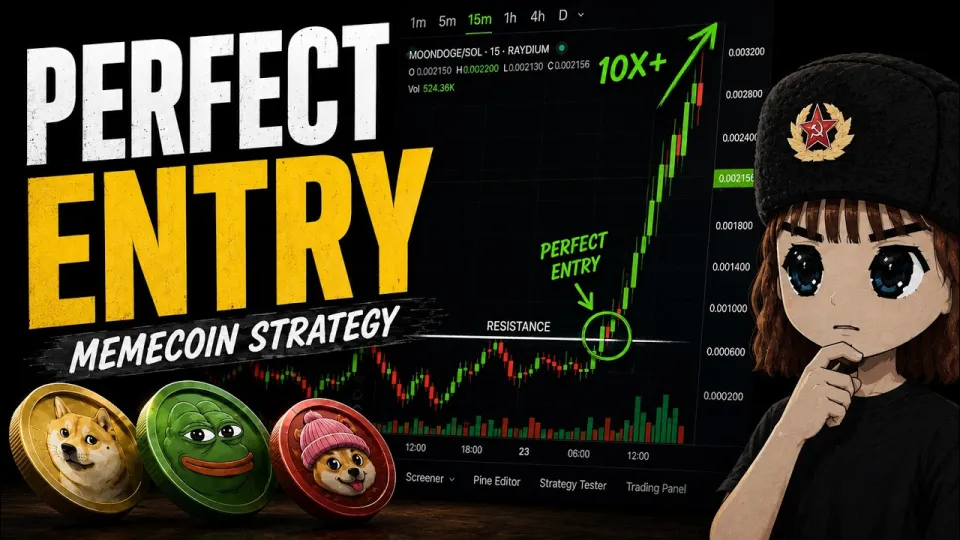
1. First pullback after the initial impulse. The coin launches, prints a strong first leg, then retraces into a prior consolidation or the 0.5–0.618 zone of that leg. You buy the reclaim of the pullback high, not the falling knife.
2. Break-and-retest of a base. Price breaks out of a flat range, holds above the breakout level, and retests it. The old resistance becomes support, and your stop sits just under the range.
3. Higher-low continuation. After two or three higher lows, a shallow dip that holds above the previous low is a lower-risk continuation entry than buying the high.
4. Volume expansion from compression. Long tight ranges on declining volume often precede expansion; entering on the first volume-backed break with a stop under the range keeps risk small.
In every case the trigger is confirmation, not prediction: you wait for the level to hold and for buyers to show up, then act.
How to avoid FOMO and identify momentum without chasing
Momentum is information, not an invitation; the goal is to use it as confirmation while refusing to pay the top tick. Chasing a vertical candle means your entry is the worst price of the move and your stop is the furthest away.
A workable filter set:
- If the last candle is more than roughly 2–3x the average candle size, you are late — wait for the retrace.
- If price is more than 20–30% above the nearest support, the stop distance is too wide for a clean risk-to-reward.
- If you cannot state your invalidation level in one sentence, skip the trade.
- If you feel urgency, that is a signal to close the terminal for ten minutes, not to size up.
FOMO is usually a symptom of no plan. When the checklist is written down, missing a move costs nothing; taking a bad entry costs capital.
Chart signals that tell you not to enter
The most valuable skill in meme coin trading is knowing when to do nothing, and there are chart signals that should veto a trade regardless of how good the narrative looks. Skipping a bad setup protects capital just as effectively as winning a good one.
Red flags worth respecting:
- Exhaustion wicks: long upper wicks on huge volume mean sellers are absorbing buyers.
- Fading volume on new highs: price makes a higher high while volume drops — the move is running on fumes.
- Failed reclaim: price breaks a key level, then closes back below it; that is a trap, not a breakout.
- Vertical structure with no base: no consolidation means no reference point for a stop.
- Sudden liquidity withdrawal: depth thinning while price holds is a setup for a violent wick.
Any one of these is a reason to wait; two together is a reason to walk away.
Planning risk, exits, and profit-taking before the trade
Risk planning happens before the entry, because once price is moving you will rationalize anything. Decide position size from the stop distance, not from how excited you are about the coin.
A simple framework:
- Define invalidation first. Mark the level where the setup is dead — usually under the pullback low or the base.
- Size from the stop. If risking 1–2% of the account and the stop is 15% away, the position size follows arithmetically.
- Set partial exits in advance. Common structure is scaling out into the first resistance and trailing the remainder behind higher lows.
- Move the stop, never the thesis. Once the trade pays, protect capital; do not widen a stop to avoid being wrong.
- Write the plan down. A one-line note with entry, stop, and targets removes emotion from execution.
Memecoins can round-trip a full gain in minutes, so profit-taking rules matter as much as entry rules.
Common beginner questions about meme coin entries
Beginners tend to ask the same things: which chain is best, whether to use trackers, and how much capital to start with. The honest answer is that the chain matters less than liquidity and structure — Solana, Base, and newer ecosystems all produce tradeable setups and all produce rugs, and the same checklist applies to each.
On tooling: trackers and terminals help you find candidates faster, but they do not replace the chart read. A filter that surfaces coins with rising volume and a formed base is useful; a filter that surfaces whatever is up 400% is a FOMO machine.
On capital: starting small is not a limitation, it is a feature — the process is what you are testing, and a small account proves the process just as well as a large one. Losing streaks are usually a signal to reduce size and review entries, not to chase harder.
Useful links
- Plasma Telegram (early access and setup help): https://t.me/+PF-2KHPgQqFiZWJh
- Discord community: https://discord.com/invite/fr6zzYyBxC
- Padre terminal: https://trade.padre.gg/rk/star
- Solpump: https://solpump.com/a/STARGOAT
- starwifpump on X: https://x.com/starwifpump
The takeaway
Meme coin trading rewards timing discipline far more than coin picking, and the process is simple even when execution is not: read volume and structure, wait for a confirmed pullback or retest, define invalidation before entry, and size the position from the stop. Signals like exhaustion wicks, fading volume, and failed reclaims exist to keep you out of trades, and respecting them is a skill worth building. The starwifpump channel built its full strategy around exactly this idea — that entry location, not narrative, decides the risk-to-reward. If you want the tooling and community around that process, start with the Plasma Telegram for early access and run the checklist on your next trade before you click buy.
Questions & answers
What is the best time to enter a meme coin?
The best entry is usually the first controlled pullback after a confirmed impulse, or a break-and-retest of a formed base. You want momentum already proven but price not yet vertical, so your invalidation level sits close and the risk-to-reward stays favorable.
How do I avoid FOMO when a meme coin is pumping?
Set rules in advance: skip entries when the last candle is several times the average size or price is far above the nearest support. If you feel urgency, that is a signal to step away from the terminal rather than size up.
Does the same entry strategy work on every chain?
Largely yes, because the checklist is about liquidity, structure, and volume rather than the specific ecosystem. Solana, Base, and newer chains all produce valid setups and all produce rugs, so apply the same confirmation and invalidation rules everywhere.
How much should I risk on a single meme coin trade?
A common approach is risking 1–2% of the account per trade, with position size calculated from the distance to your invalidation level. If the stop is far away, the position must be smaller — never the other way around.
Source: How I Find the PERFECT Entry on Memecoins 📈 (Full Strategy) · Markdown version